
Introduction
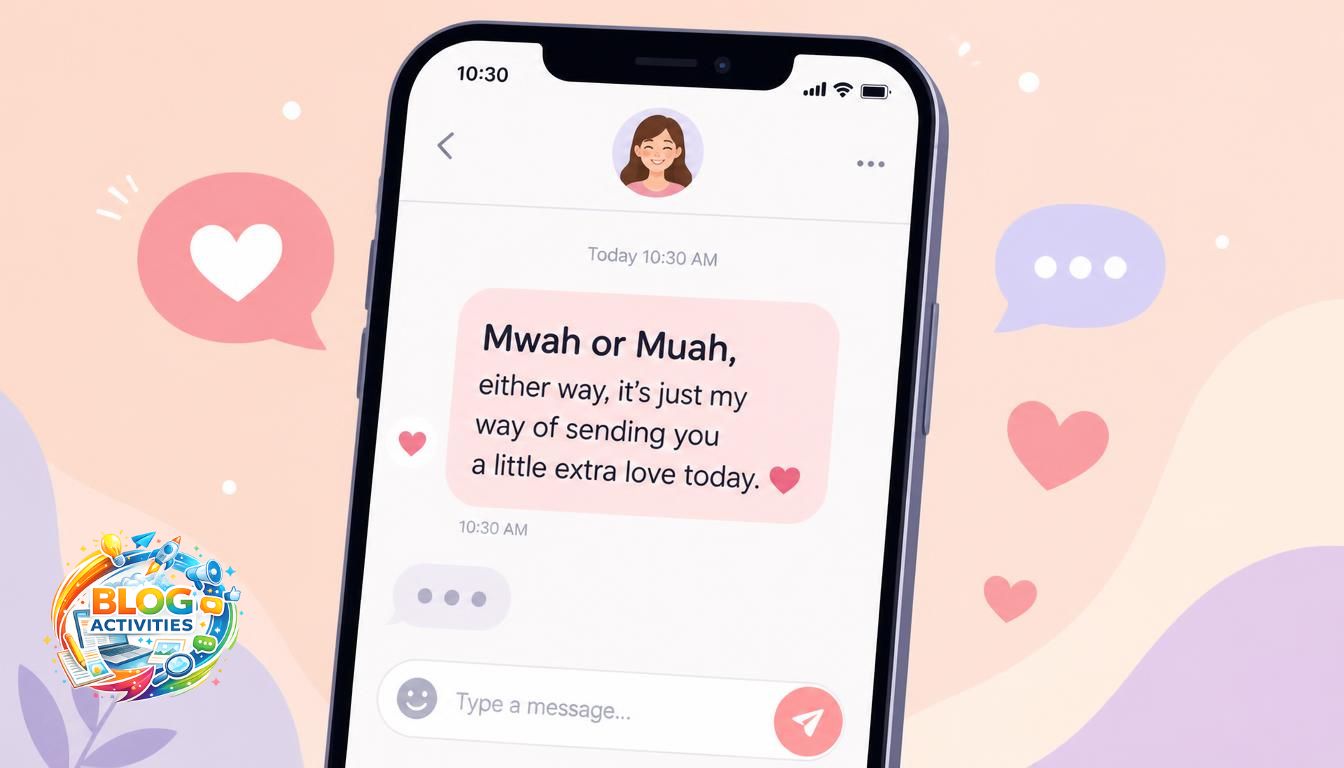
Small expressions can carry a surprising amount of emotion in everyday communication. “Mwah” and “muah” are two familiar examples. You may see them at the end of a text message, in a social media comment, or as a playful way to say goodbye. Although they look like ordinary words, they are mainly written representations of a kissing sound.
The mwah or muah expression is informal and is generally associated with a kiss, affection, warmth, or a playful gesture. Cambridge Dictionary defines mwah as an informal exclamation used to represent the sound of kissing, particularly the kind of kiss associated with greeting someone on or near the cheek. Oxford gives a similar definition and also lists “mwa” as another form.
Because people write sounds in different ways, it is natural to wonder whether mwah or muah is the correct spelling. The simple answer is that both forms are used to represent essentially the same idea. Mwah has clear dictionary recognition, while muah is commonly treated as an alternative spelling of the kiss sound.
This article explains what these expressions mean, where they fit into casual communication, how context affects their tone, and why one person might write “mwah” while another prefers “muah.”
BIO
| Label | Information |
|---|---|
| Expression | Mwah or Muah |
| Meaning | A written kiss sound |
| Type | Informal expression |
| Main Use | Showing affection or warmth |
| Common Setting | Texts and online chats |
| Tone | Friendly, playful, or affectionate |
| Romantic Meaning | Depends on the context |
| Common Spelling | Mwah |
| Alternative Spelling | Muah |
| Other Form | Mwa |
| Extended Form | Mwahhh |
| Best For | Casual conversations |
| Formal Use | Generally not recommended |
What Does Mwah or Muah Mean?
At its simplest, mwah or muah means the sound of a kiss. It is not normally an abbreviation in the traditional sense. Instead, it is a written attempt to reproduce a sound or gesture using letters.
For example, someone might write:
“Good night, mwah!”
The expression suggests a kiss as part of the goodbye. Similarly:
“Thanks for helping me, muah!”
Here, the expression can add a playful or affectionate touch to the message.
Cambridge specifically describes mwah as an informal exclamation representing the sound of kissing. Oxford likewise explains that it represents the sound some people make when kissing someone on the cheek.
The important point is that mwah or muah does not have one emotional meaning in every situation. Depending on the conversation, it can communicate friendliness, affection, gratitude, humor, or a playful kiss.
Why Do People Write Mwah?
The word mwah is an example of language being used to imitate a sound. This kind of word formation is often associated with onomatopoeia, where written forms attempt to resemble sounds.
A kissing sound is difficult to represent perfectly with ordinary letters. Writers have therefore used different spellings to approximate what the sound feels like.
One linguistic discussion of kiss sounds points out that many languages use combinations of sounds involving the lips to represent kissing. Written versions can vary considerably from one language to another.
The spelling mwah works well visually because the opening “mw” suggests the movement of the lips, while the ending gives the expression an open, audible quality.
It is also short. In a quick conversation, writing “mwah” takes less effort than explaining that you are sending or making a kissing gesture. That makes the expression particularly convenient in informal digital communication.
Is Muah the Same as Mwah?
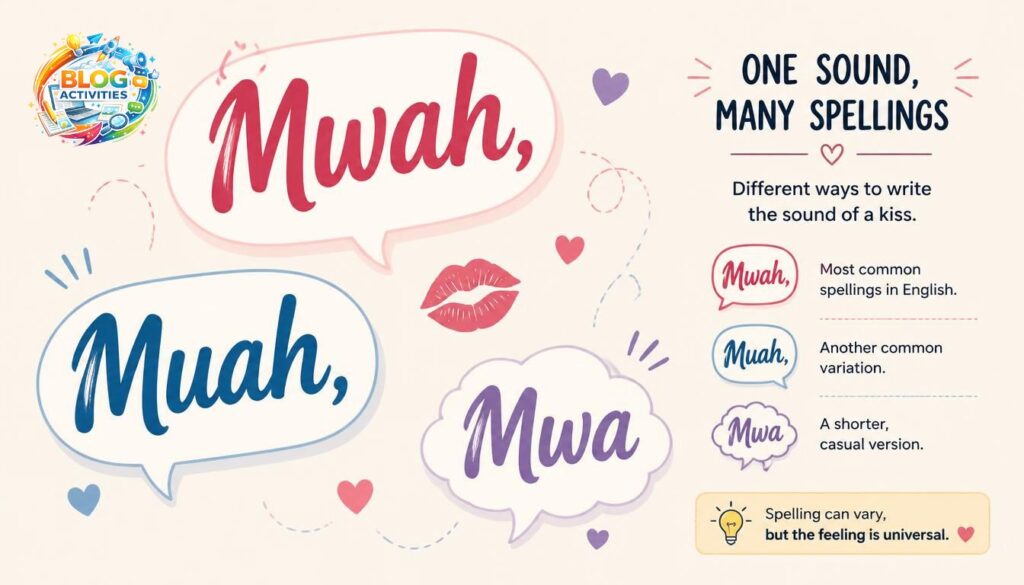
In most casual contexts, muah and mwah communicate the same basic idea.
Mwah is the spelling that receives clear treatment in major English dictionaries. Cambridge and Oxford both recognize it as an informal expression representing a kissing sound.
Muah is commonly used as an alternative spelling. Wiktionary lists muah as an alternative form associated with the kiss sound.
The difference is therefore mostly one of spelling and personal style, rather than meaning.
For example:
“See you tomorrow, mwah!”
and
“See you tomorrow, muah!”
would normally be understood in much the same way.
Some people may feel that “muah” looks softer or more playful, while “mwah” may look closer to the way the sound is normally represented. Those impressions are subjective rather than strict rules of English.
How Mwah or Muah Is Used in Conversations
The meaning of mwah or muah depends heavily on the surrounding message.
A person might use it as a warm sign-off:
“Take care, mwah.”
Someone could also use it after expressing appreciation:
“You are so kind. Muah!”
In another conversation, the same expression might simply be humorous.
This flexibility is one reason the expression works well in casual communication. It can add emotion without requiring a long explanation.
The expression can also be repeated:
“Mwah, mwah!”
Repeating it can make the message feel more exaggerated or theatrical. Collins gives examples of mwah being used in repeated form, including social situations involving cheek-kissing.
The surrounding words, punctuation, and relationship between the people involved all help determine how the message should be understood.
Mwah or Muah in Texting
Texting has changed the way people communicate emotions. In face-to-face conversations, facial expressions, gestures, tone of voice, and physical actions provide information that written messages cannot easily reproduce.
Expressions such as mwah help fill part of that gap.
A person cannot literally give a kiss through a text message, but writing “mwah” can symbolically communicate the gesture.
For example:
“Good luck today, mwah!”
The word adds warmth to what would otherwise be a straightforward sentence.
Likewise:
“Thanks for everything, muah!”
can make the message feel more expressive.
Texting dictionaries and slang references commonly describe mwah or muah as a way to communicate a kiss in written conversation.
Still, it is important to remember that these are informal expressions. They belong naturally in casual conversations rather than highly formal writing.
Mwah or Muah on Social Media
Social media has made short emotional expressions even more visible. People frequently use brief words, abbreviations, emojis, and sound representations to communicate feelings quickly.
Mwah or muah can appear in casual comments, captions, replies, or sign-offs.
For example:
“Love this photo, mwah!”
or:
“Thank you for the sweet message, muah!”
The expression can also be combined with an emoji. A kiss-face emoji or heart may reinforce the intended affectionate tone.
However, the meaning still depends on context. A comment between close friends may be completely playful, while the same expression in another conversation could be interpreted as more affectionate.
That is why it is better to understand the whole message rather than interpreting “mwah” in isolation.
Is Mwah Always Romantic?
No. Mwah does not automatically mean romance.
This is one of the most important points to understand about the expression.
A kiss can represent different kinds of affection, and written communication works the same way. Someone might use “mwah” as a friendly, playful sign-off without intending a romantic message.
For instance:
“Thanks for helping me with that, mwah!”
could simply be an exaggerated way of showing appreciation.
At the same time, a person could use the same expression in a more affectionate conversation.
The surrounding language provides the clues. Words such as “love,” “miss you,” or other strongly affectionate statements may give the message a different tone. Without that context, it is difficult to assign a single emotional interpretation to the word.
Therefore, mwah is better understood as a flexible expression of a kiss or affection rather than a guaranteed romantic signal.
When Is Mwah or Muah Appropriate?
Because these expressions are informal, they work best in relaxed communication.
They can fit naturally in:
- Casual text messages
- Friendly conversations
- Informal social media comments
- Playful messages
- Affectionate conversations
- Casual goodbyes
They are less suitable for formal situations.
For example, ending a formal school or professional message with “Mwah!” could seem unusual or inappropriate because the tone does not match the setting.
A more formal message would normally use a conventional closing instead.
This distinction is important because good communication is not only about what a word means; it is also about whether the word matches the situation.
What Does Mwahhh Mean?
You may also encounter longer versions such as “mwahhh” or “muahhh.”
The additional letters usually do not create a completely different dictionary meaning. Instead, they add emphasis or exaggeration.
Compare:
“Mwah.”
with:
“Mwahhh!”
The second version may feel more playful, dramatic, enthusiastic, or expressive.
This is common in informal online writing. People often extend letters to make a message sound more emotional or to imitate the way a person might stretch a sound while speaking.
Similarly, punctuation can change the appearance and perceived tone:
“Mwah!”
feels more energetic than:
“mwah.”
Neither version has a fixed emotional rule, but the presentation can influence how the reader perceives the message.
Mwah or Muah and Air Kisses
The connection between mwah and the idea of an air kiss is especially interesting.
An air kiss is a social gesture in which someone makes a kissing motion without an ordinary kiss taking place. The gesture can be accompanied by a kissing sound, which is where an expression such as “mwah” fits naturally.
The written word can therefore represent not only the sound of a physical kiss but also the idea of sending a symbolic kiss.
This helps explain why mwah or muah works so naturally in digital communication. A text cannot reproduce a physical gesture, but a short written sound can represent it.
Why Are There Different Spellings?
There is no single reason why people choose different spellings for sound-based expressions.
Unlike highly standardized words, expressions such as mwah are closely connected to speech, imitation, and informal writing. People hear a sound and spell it according to how they think it should look.
That can produce forms such as:
Mwah
Muah
Mwa
Mouah
Some forms may be more common in particular communities or languages.
Oxford lists mwa as another form of mwah, while Wiktionary records several alternative forms.
This variation is not surprising. Written representations of sounds often develop differently from conventional vocabulary because people are trying to capture something they hear rather than follow a fixed spelling rule.
Which Is Correct: Mwah or Muah?
If you are asking which spelling has the strongest formal dictionary recognition in English, mwah is the safer answer.
Cambridge, Oxford, and Collins all recognize mwah as an informal expression representing a kiss sound.
However, that does not mean muah is incomprehensible or unusable. It is widely recognizable as an alternative spelling of the same basic expression.
So, in casual communication, the practical answer is:
Mwah = established dictionary form
Muah = commonly understood alternative spelling
If you are writing a formal article about English vocabulary, “mwah” is the stronger choice when discussing the dictionary entry. If you are casually texting someone, either form can communicate the intended kiss sound.
How to Respond to Mwah or Muah
There is no universal response because the appropriate reply depends on the relationship and conversation.
If someone sends a casual “mwah,” you can simply continue the conversation normally.
If the tone is playful, a similarly light response may make sense.
If the person is using it as an affectionate sign-off, you might respond with a warm goodbye.
The key is matching the tone without assuming more meaning than the conversation supports.
For example, if a friend writes:
“Thanks for helping me, mwah!”
there is no reason to automatically interpret the expression as romantic. It may simply be an affectionate or humorous way of saying thanks.
Context is more reliable than the word alone.
Common Variations
The basic expression can appear in several forms.
Mwah is the standard dictionary-recognized form.
Muah is a common alternative spelling.
Mwa is another shortened form recognized by Oxford.
Mwahh or mwahhh can add emphasis.
Mwah, mwah can represent repeated kisses or a more exaggerated expression.
The capitalization can also change depending on the position in a sentence. None of these variations necessarily changes the fundamental concept: they represent a kiss sound or symbolic kiss.
The Human Side of Mwah or Muah
Part of the appeal of mwah or muah comes from its simplicity.
Digital communication can sometimes feel emotionally limited because a written sentence does not contain all the cues present in a face-to-face interaction. A tiny expression can make a message feel more personal.
Compare:
“Good night.”
with:
“Good night, mwah!”
The second message contains an additional emotional cue. The word suggests warmth or affection without requiring a long explanation.
That does not mean every reader will interpret it in exactly the same way. Communication is influenced by relationships, culture, personality, and context. Still, the expression demonstrates how creative informal language can make digital conversations feel more expressive.
Mwah or Muah: A Simple Guide
If you are unsure which version to use, there is no need to overthink it.
Use mwah when you want the spelling that is directly supported by major English dictionaries.
Use muah when that spelling feels more natural to you or matches the style of the conversation.
Keep either form for casual and informal communication, especially when you already have a friendly relationship with the person.
Most importantly, consider the context. A word representing a kiss can be playful, friendly, affectionate, or romantic depending on the surrounding message.
Conclusion
Mwah or muah is a small but expressive part of modern informal communication. Both spellings are used to represent the sound or idea of a kiss, particularly in casual messages and online conversations.
Among the two, mwah has stronger formal dictionary recognition, with Cambridge, Oxford, and Collins all defining it as an informal representation of a kissing sound. Muah is commonly understood as an alternative spelling.
The expression does not automatically indicate romance. Depending on the situation, it can communicate friendliness, affection, appreciation, humor, or a symbolic kiss.
Ultimately, the most important factor is context. The people involved, the surrounding words, and the overall tone of the conversation usually tell you more than the spelling itself.
How Crew Cloudysocial Can Improve Your Social Strategy
Frequently Asked Questions
What does “mwah” mean in texting?
Mwah usually represents the sound of a kiss. In texting, it can be used to send a symbolic kiss or add affection and warmth to a casual message.
What does “muah” mean in a text?
Muah generally represents the same kiss sound as “mwah.” It is commonly used as an informal expression of a kiss or affection.
Is mwah the same as muah?
In most casual conversations, yes. The two spellings generally communicate the same basic idea, although “mwah” has clearer recognition as a dictionary entry.
Is mwah always romantic?
No. Mwah can be friendly, playful, affectionate, or romantic. The intended meaning depends on the relationship and surrounding conversation.
Which spelling is correct, mwah or muah?
Mwah is the form recognized by major English dictionaries such as Cambridge, Oxford, and Collins. “Muah” is also commonly used as an alternative spelling in informal communication.
What does “mwahhh” mean?
“Mwahhh” normally means the same basic thing as “mwah,” but the extra letters add emphasis, exaggeration, or a playful tone.
Can friends use mwah?
Yes. Friends can use mwah in casual communication. It does not automatically imply romantic interest.
Is mwah appropriate in formal writing?
Generally, no. Mwah is an informal expression and is better suited to casual conversations, texts, and social media rather than formal academic or professional writing.
Why are there different spellings of the kiss sound?
Because the expression represents a sound rather than a conventional word with one fixed spelling. Different writers may spell the sound differently. Major dictionaries recognize forms such as mwah and mwa, while “muah” is commonly used as an alternative form.
What is the simplest meaning of mwah or muah?
The simplest meaning is “a kiss” or “the sound of a kiss.” In casual communication, it can also add warmth, affection, or playfulness to a message.