

If you have come across the term FAFO in a text message, social media comment, meme, or online discussion, you may have wondered what it means. The short answer is that FAFO stands for “F* Around and Find Out.”** It is an informal and vulgar slang expression used to suggest that someone who takes a risk, ignores a warning, causes trouble, or pushes a boundary may eventually face the consequences.
Although the phrase can sound harsh, its tone depends heavily on the situation. Among friends, FAFO can be used jokingly. In an argument, it may sound confrontational. In a comment about someone’s poor decision, it can simply mean that the person is experiencing the result of their actions.
The acronym has become particularly recognizable through internet culture and social media. However, the underlying phrase existed before the modern acronym became widely popular online.
BIO
| Label | Information |
|---|---|
| Term | FAFO |
| Full Form | Fuck Around and Find Out |
| Type | Internet slang |
| Meaning | Actions can lead to consequences |
| Common Use | Casual online conversations |
| Origin | Modern slang culture |
| Popularity | Widely used on social media |
| Tone | Informal and sometimes blunt |
| Context | Memes, comments, posts, and chats |
| Purpose | Expresses a warning or consequence |
| Audience | Mostly casual online users |
| Related Idea | Actions have consequences |
What Does FAFO Stand For?
FAFO stands for “F* Around and Find Out.”** The first part refers to taking chances, provoking a situation, ignoring advice, or behaving in a way that could have consequences. The second part refers to eventually discovering what those consequences are.
In simple terms, FAFO communicates the idea that actions have consequences.
For example, imagine someone repeatedly ignores a clear warning and eventually gets into trouble because of that decision. Someone watching the situation might simply comment, “FAFO.” In that context, the person is saying that the outcome was predictable because the individual continued taking unnecessary risks.
Dictionary.com classifies FAFO as vulgar slang and defines it as an abbreviation used as a warning or challenge involving unwanted consequences. It also recognizes the phrase as a verb in informal usage.
Because the original phrase contains profanity, FAFO is generally best understood as casual internet slang rather than appropriate language for formal writing.
What Does FAFO Mean in Simple Terms?
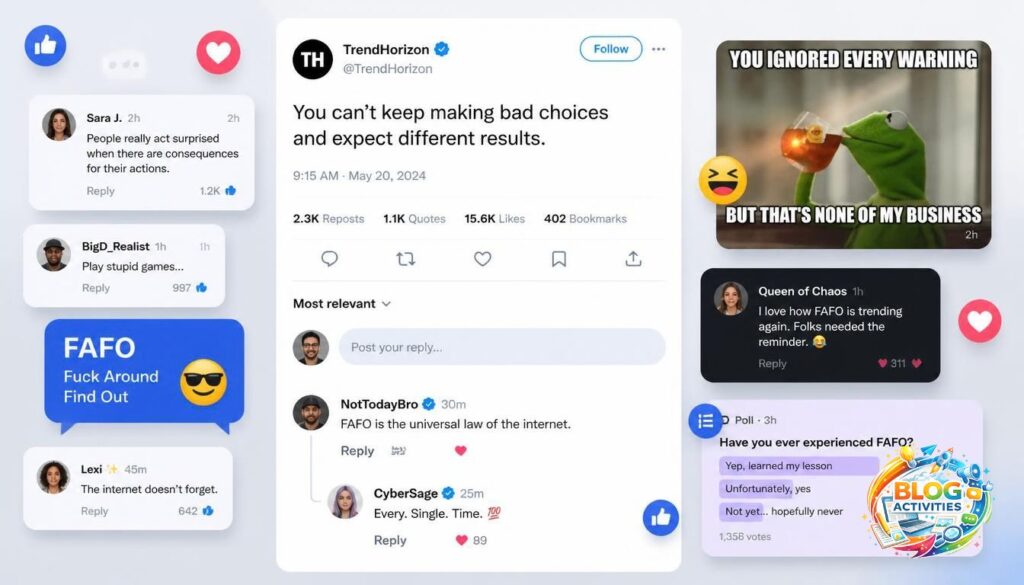
The easiest way to understand FAFO is to think of it as a blunt version of “you were warned, and now you are dealing with the result.”
The expression usually contains two ideas:
Taking the risk: Someone chooses to push a limit, ignore advice, provoke a situation, or make a questionable decision.
Facing the result: The person’s decision eventually produces a consequence that they have to deal with.
This does not necessarily mean that something extremely serious has happened. Online, people often use FAFO for relatively ordinary situations.
For instance, a person might ignore advice about a simple task, make a mistake, and then have to correct it. A friend could jokingly describe the situation as FAFO.
That is one reason the expression has become so flexible. Its basic message remains the same, but the seriousness can change according to context.
Where Did FAFO Come From?
The exact origin of the full expression is difficult to establish. It is not accurate to say with certainty that one specific person, website, or social media platform invented it.
The phrase “fuck around and find out” existed in informal English before FAFO became a widely recognized internet acronym. A documented example appears in Wiktionary’s historical citations from the 2010s, while the acronym and phrase have circulated through different informal communities.
Know Your Meme describes the modern history as unclear but notes that the expression became particularly visible online through meme culture. It also documents an association with parody versions of the Gadsden Flag and later internet communities.
This distinction is important. The internet did not necessarily create the phrase, but internet culture helped turn it into a recognizable acronym.
As people increasingly shortened phrases for texts, captions, comments, and memes, FAFO became an efficient way to express a larger idea using only four letters.
How Is FAFO Used in Texting and Social Media?
FAFO is commonly used in informal digital communication because it is short and immediately recognizable to people familiar with internet slang.
Someone might use it in a text conversation after a friend makes a questionable decision. It can also appear in a comment beneath a video where someone ignored an obvious warning.
The meaning can range from humorous to serious.
For example, a friend might use FAFO jokingly after another friend makes a harmless mistake. In a more heated discussion, however, the same acronym can sound like a warning or challenge.
Context matters more than the four letters themselves.
Social media has also helped the phrase become recognizable beyond ordinary text conversations. It has appeared in memes, reaction posts, political discussions, and other online communities. Know Your Meme documented the phrase’s growth as an internet catchphrase and its increasing visibility during the 2020s.
FAFO Examples in Everyday Conversations
Understanding examples makes the meaning much easier to recognize.
Imagine a person repeatedly ignores advice from their friends and then complains when the predictable result occurs. Someone might respond with “FAFO.” The message is essentially that the person chose to take the risk and is now dealing with the outcome.
Another example could involve a social media post. Someone shares a story about ignoring a clear warning and then facing an inconvenience because of it. A commenter may use FAFO as a short reaction.
The phrase can also be used humorously.
Suppose someone says, “I knew I shouldn’t have tried to fix it myself, but I did anyway.” If the attempt goes badly, a friend familiar with internet slang might respond with FAFO.
In each example, the central idea is cause and effect.
The acronym does not necessarily provide a detailed explanation. Instead, it acts as a compact reaction to a situation where someone’s decision has produced an expected result.
What Does FAFO Mean in Different Contexts?
FAFO in Text Messages
In texting, FAFO is usually casual. Friends may use it when discussing decisions, mistakes, arguments, or situations where someone ignored a warning.
Because text messages do not always show facial expressions or tone of voice, the same acronym can sometimes be interpreted differently.
A close friend may intend it as a joke, while another person might read it as aggressive. Knowing the relationship between the people involved is therefore important.
FAFO on Social Media
On social media, FAFO is often used as a reaction to posts, videos, memes, or stories involving consequences.
A user might see someone making a questionable decision and comment FAFO. Another person may use it after an outcome has already happened.
The expression works particularly well in online communication because it is short, memorable, and easy to understand once the slang is familiar.
FAFO in General Conversations
In ordinary conversation, people may use the full phrase rather than the acronym.
The underlying meaning remains the same: someone takes a particular action and eventually experiences its consequences.
The phrase can be humorous, sarcastic, cautionary, or confrontational depending on how it is delivered.
FAFO in Public Discussions
FAFO has also appeared in broader public and political discussions. Its use in these settings shows how internet slang can move beyond private conversations and become part of wider public language.
That does not make the expression formal, however. It remains slang and can carry a deliberately blunt tone.
Is FAFO Considered Rude or Offensive?
Yes, FAFO can be considered rude or offensive, mainly because its standard expansion contains profanity.
The acronym itself may look relatively harmless to someone unfamiliar with it, but people who know the full phrase understand its stronger tone.
Whether it is inappropriate depends on the audience and setting.
Using FAFO with close friends may be acceptable in a casual conversation. Using it in a school assignment, formal email, job application, professional presentation, or other formal communication would generally be a poor choice.
The phrase can also sound threatening when directed at another person during an argument. For that reason, it is worth considering the situation before using it.
A more neutral alternative is “actions have consequences.” Other options include “you were warned,” “that was predictable,” or “you have to deal with the result.”
These alternatives communicate a similar idea without the profanity.
Why Has FAFO Become So Popular?
One major reason for FAFO’s popularity is its ability to communicate a complete idea in just four letters.
Internet communication often favors short expressions. People communicate through comments, captions, memes, short messages, and reaction posts, so acronyms can spread quickly.
FAFO also expresses a concept that is easy to understand: if you deliberately take a risk, you may eventually experience the consequences.
The expression can also be adapted to many situations. It can describe a joke between friends, a bad decision, an online argument, or a reaction to a story.
Another factor is meme culture. Short phrases that work well as captions or reactions can spread rapidly when they are repeatedly used in recognizable situations.
Know Your Meme traces FAFO’s growing online visibility through the 2020s, while Dictionary.com now lists the acronym as an established slang term.
FAFO vs. Similar Internet Slang
FAFO is related to several expressions that communicate the idea of consequences, but the tone is different.
One similar expression is “play stupid games, win stupid prizes.” Both phrases criticize poor decisions and suggest that actions can produce undesirable results.
The difference is that FAFO is shorter and generally more blunt.
Another related idea is “you reap what you sow.” This is much more traditional and less confrontational. It communicates the general principle that a person’s actions can eventually return to them through their consequences.
“Actions have consequences” is even more neutral.
FAFO, by comparison, has a distinctly informal internet-slang character. Its stronger wording gives it an attitude that the alternatives usually do not have.
How to Use FAFO Correctly
The most important rule is to consider your audience and the setting.
If you are talking with friends who regularly use internet slang, FAFO may be understood immediately. If you are communicating with teachers, employers, customers, or other professional contacts, a more neutral phrase is usually better.
It is also important to consider tone.
Using FAFO as a joke with a friend can be very different from directing it at someone during a disagreement. In the second situation, it may sound aggressive or threatening even if that was not the intention.
Before using it, ask yourself whether the person receiving the message is likely to understand the slang and whether the tone fits the situation.
Common Misunderstandings About FAFO
One common misunderstanding is assuming that FAFO always describes a serious or dangerous situation. It does not.
The expression can be used for something as simple as making a silly decision and experiencing an inconvenient result.
Another misunderstanding is assuming that the acronym has one confirmed historical inventor. The available evidence does not support a simple origin story involving one universally accepted creator. The phrase existed in informal language before its modern social-media popularity.
People can also misunderstand the tone. FAFO may be funny in one conversation and offensive in another.
That is why context is essential when interpreting internet slang.
Is FAFO Always a Warning?
Not necessarily.
FAFO can function as a warning, but it can also be a reaction after something has already happened.
For example, if someone has been warned repeatedly and then experiences the result they were warned about, another person might use FAFO as a brief way of commenting on the situation.
It can also be used sarcastically or humorously.
The key idea is not the timing but the connection between a person’s choice and the resulting consequence.
Can FAFO Be Used in Formal Writing?
Generally, no.
FAFO is informal and vulgar slang. Even though dictionaries now recognize the acronym, that does not make it appropriate for every setting.
In an academic paper, professional email, business report, or formal article, it is usually better to explain the idea using neutral language.
For example, instead of FAFO, you could write “actions can have consequences” or “the decision ultimately resulted in predictable consequences.”
These alternatives preserve the meaning while maintaining a professional tone.
What Does FAFO Really Mean?
At its core, FAFO is a compact way of expressing a familiar idea: people may eventually experience the consequences of the choices they make.
The phrase is stronger and more informal than “actions have consequences,” which is why it is particularly common in casual online conversations.
Its meaning can shift slightly depending on the situation. It can be humorous, sarcastic, cautionary, or confrontational. Understanding the surrounding conversation is therefore essential.
The acronym’s popularity also demonstrates how internet culture changes language. A longer slang phrase became a four-letter abbreviation that can now be recognized across many online communities.
Elaine Starchuk Biography: Facts About Her Private Life
Frequently Asked Questions About FAFO
What does FAFO stand for?
FAFO stands for “F* Around and Find Out.”** It is vulgar, informal slang used to describe the idea that risky, provocative, or careless actions can lead to consequences.
What does FAFO mean in texting?
In texting, FAFO usually means that someone is taking a risk or ignoring a warning and may eventually have to deal with the result. Depending on the conversation, it can be humorous, sarcastic, or serious.
Is FAFO a bad word?
FAFO is considered vulgar slang because its standard expansion contains profanity. The acronym itself is less explicit than spelling out the full phrase, but it can still be inappropriate in formal settings.
Where did FAFO originate?
The exact origin is unclear. The full expression existed before the acronym became popular online, and there is no universally confirmed individual credited with inventing it.
Can FAFO be used professionally?
It is generally best avoided in professional communication. Because it is informal and contains profanity in its full form, neutral expressions such as “actions have consequences” are more suitable.
Conclusion
So, what does FAFO stand for? It stands for “F* Around and Find Out,”** an informal slang expression built around the idea that choices can lead to consequences.
The phrase has become especially recognizable through social media, memes, texting, and online discussions. Its meaning is usually straightforward, but its tone depends on context. It can be playful among friends, sarcastic in an online comment, or much more confrontational during an argument.
Although FAFO is now widely recognized as internet slang, the underlying phrase predates its modern online popularity. Its exact origins are difficult to establish, so it is better to view its history as a gradual development rather than attribute it to one confirmed creator.
For readers encountering the acronym for the first time, the simplest interpretation is this: someone takes a risk, ignores a warning, or pushes a boundary, and eventually discovers the consequences.
Knowing that meaning makes it much easier to understand FAFO when it appears in texts, comments, memes, and casual online conversations.