
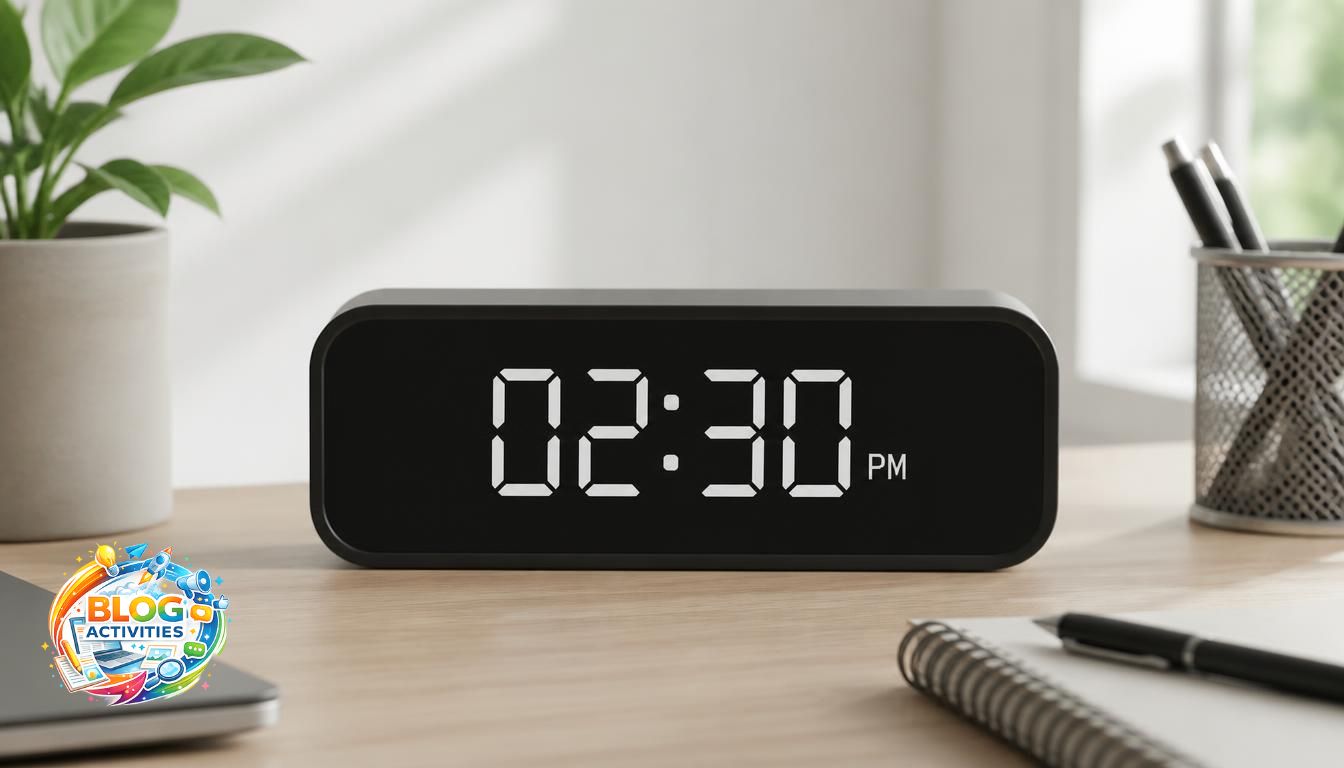
Knowing how long until 2:30 PM today can help you plan your afternoon, prepare for an appointment, finish your work, or simply keep track of an important event. Although calculating the remaining time may seem simple, the answer changes every minute, depending on your current local time.
For example, if it is 12:00 PM, you have two hours and 30 minutes until 2:30 PM. If it is 1:45 PM, you have only 45 minutes left. Once the clock reaches 2:30 PM, the target time has arrived.
The easiest way to find the exact answer is to check your current time and calculate the difference between now and your target time. You can also use a digital clock, a countdown timer, or a reminder on your phone.
In this guide, you will learn how to calculate the time remaining until 2:30 PM, understand AM and PM, handle situations when 2:30 PM has already passed, and use simple tools to manage your daily schedule more effectively.
BIO
| Label | Information |
|---|---|
| Topic | How Long Until 2:30 PM Today |
| Category | Time & Date |
| Main Keyword | how long until 2:30 pm today |
| Topic Type | Time Calculation |
| Purpose | Calculate the time remaining until 2:30 PM |
| Target Time | 2:30 PM |
| Time Format | 12-hour clock |
| 24-Hour Format | 14:30 |
| Calculation Method | Subtract the current time from the target time |
| Time Reference | Current local time |
| Common Use | Appointments, meetings, and daily planning |
| Helpful Tools | Digital clocks, alarms, and countdown timers |
| Key Consideration | Time remaining changes every minute |
How Long Until 2:30 PM Today?
The time remaining until 2:30 PM depends on the current time where you are. There is no single countdown that stays correct throughout the day because every passing minute changes the answer.
If your local clock shows a time before 2:30 PM, subtract the current time from 2:30 PM to determine how long you need to wait.
Here are a few examples:
- 12:00 PM: 2 hours and 30 minutes remain.
- 12:30 PM: 2 hours remain.
- 1:00 PM: 1 hour and 30 minutes remain.
- 1:30 PM: 1 hour remains.
- 2:00 PM: 30 minutes remain.
- 2:15 PM: 15 minutes remain.
- 2:25 PM: 5 minutes remain.
These examples make it easy to estimate the countdown without using a calculator. If the current time falls between these examples, you can calculate the remaining minutes using the same method.
For instance, if it is 1:52 PM, you have 38 minutes until 2:30 PM. From 1:52 PM to 2:00 PM is eight minutes, followed by another 30 minutes to reach the target.
The most important point is to check your local time first. A countdown that is correct at noon will no longer be correct at 1:00 PM, so always base your calculation on the current clock.
How to Calculate the Time Until 2:30 PM
Calculating the time until 2:30 PM is straightforward once you know the current hour and minute. You do not need a special app or complicated mathematical skills. A regular clock is enough for most situations.
Follow these simple steps:
- Check the current time on your phone, computer, or watch.
- Confirm that the target is 2:30 PM today.
- Calculate how many minutes remain until 2:30 PM.
- Express the answer in hours and minutes if necessary.
For example, suppose your clock shows 12:40 PM. From 12:40 PM to 1:00 PM is 20 minutes. From 1:00 PM to 2:00 PM is another hour, and from 2:00 PM to 2:30 PM is 30 minutes.
Add those intervals together, and you get 1 hour and 50 minutes.
Another example is 1:18 PM. There are 42 minutes until 2:00 PM, followed by another 30 minutes until 2:30 PM. Therefore, the remaining time is 72 minutes, or 1 hour and 12 minutes.
These examples show why breaking a calculation into smaller intervals can make it easier to understand.
A Simple Formula for Finding the Remaining Time
You can also use a basic subtraction method.
Convert both times into minutes after midnight, then subtract the current time from the target time. For 2:30 PM, the target equals 14 hours and 30 minutes after midnight, or 870 minutes.
Suppose it is currently 1:20 PM. That time equals 800 minutes after midnight.
The calculation is:
870 − 800 = 70 minutes
This means you have 70 minutes, or 1 hour and 10 minutes, until 2:30 PM.
You do not need to perform this conversion every time. It is simply a reliable method when the current time includes minutes and you want an exact answer.
What If It Is Already Past 2:30 PM?
Sometimes, you might check the clock and discover that 2:30 PM has already passed. In that situation, the answer depends on whether you mean the time remaining until the next 2:30 PM or how long ago today’s target occurred.
For example, if the current time is 3:00 PM, then 2:30 PM was 30 minutes ago. If it is 5:15 PM, the target time passed 2 hours and 45 minutes earlier.
If you want to know when 2:30 PM will occur again, you must calculate the time until tomorrow afternoon.
Here are a few examples:
- At 3:00 PM, the next 2:30 PM is 23 hours and 30 minutes away.
- At 4:00 PM, the next 2:30 PM is 22 hours and 30 minutes away.
- At 6:30 PM, the next 2:30 PM is 20 hours away.
- At 10:00 PM, the next 2:30 PM is 16 hours and 30 minutes away.
The important distinction is between a time that has already passed and a time that is still approaching. If your goal is to attend an appointment scheduled for today, knowing that the target has passed may be more useful than calculating the next occurrence.
If you are planning for tomorrow, make sure your calculation uses the correct date.
Is 2:30 PM in the Morning or Afternoon?
The time 2:30 PM refers to the afternoon, not the morning. It means two hours and 30 minutes after noon.
The 12-hour clock divides the day into two periods: AM and PM. AM generally covers the time from midnight until just before noon, while PM covers the time from noon until just before midnight.
The distinction matters because 2:30 AM and 2:30 PM occur 12 hours apart.
For example:
- 2:30 AM: Half past two in the early morning.
- 2:30 PM: Half past two in the afternoon.
- 14:30: The 24-hour clock equivalent of 2:30 PM.
On a 24-hour clock, the afternoon hours continue from 12:00 through 23:59. Therefore, converting 2:30 PM to 14:30 can help prevent confusion when reading schedules, transport timetables, or digital displays.
The National Institute of Standards and Technology explains that AM and PM refer to times before and after noon, respectively, and recommends avoiding ambiguous references to noon and midnight.
NIST
+1
Why People Want to Know How Long Until 2:30 PM
A specific time can be important for many everyday reasons. Knowing how long remains until 2:30 PM helps people organize their activities, manage deadlines, and prepare for scheduled events.
Work and office schedules: Someone may have an afternoon meeting, a scheduled break, or a task that needs to be completed before 2:30 PM. Calculating the remaining time helps them decide how to organize their workload.
School and study plans: Students may need to finish an assignment, prepare for a lesson, or get ready for an activity that starts in the afternoon. A countdown can help them divide their available time into manageable tasks.
Appointments and personal plans: A doctor’s appointment, family meeting, online class, or scheduled phone call may be set for 2:30 PM. Knowing the remaining time makes it easier to prepare without constantly checking the clock.
Travel and transportation: A person leaving for a bus, train, or other scheduled journey may want to know how much time is available before departure. They should also account for travel time and possible delays instead of relying only on the countdown.
Daily routines: People often use specific times as reminders to begin an activity, take a break, prepare a meal, or switch to another task. A clear time calculation can make these routines easier to follow.
In each situation, the countdown is useful because it turns a target time into a practical amount of time available. Rather than thinking vaguely about the afternoon, you can make a more informed decision about what to do next.
How to Track the Countdown to 2:30 PM
If you need to know exactly how much time remains, using a clock or countdown timer can be more convenient than calculating the difference repeatedly.
Several simple options can help you keep track of the time.
- Phone clock: Check the current time whenever you need an update.
- Computer clock: Use the clock displayed on your desktop or laptop.
- Alarm or reminder: Set an alert for 2:30 PM so you do not have to keep watching the clock.
- Countdown timer: Enter the remaining hours and minutes to see the time decrease.
- Calendar reminder: If 2:30 PM is connected to an appointment, create a calendar event with an alert.
A countdown timer is particularly helpful when you are working toward a deadline. For example, if you have 40 minutes remaining, you can decide which tasks you can reasonably complete before the target time.
However, remember that a timer only stays accurate if it starts with the correct duration. If you set a timer for one hour at 1:00 PM, it will reach zero at 2:00 PM, not 2:30 PM.
For the best results, check your clock before starting the countdown and update it if your plans change.
Does the Time Until 2:30 PM Depend on Your Location?
Yes, your location matters when you are referring to local clock time. Different parts of the world use different time zones, so 2:30 PM in one location does not necessarily occur at the same moment as 2:30 PM somewhere else.
For example, if you have an online meeting scheduled for 2:30 PM in another country, you need to confirm which location’s time the organizer is using. Otherwise, you could calculate the countdown incorrectly.
Time zones are generally expressed as offsets from Coordinated Universal Time, commonly abbreviated as UTC. Some locations also adjust their clocks seasonally for daylight saving time. These changes can affect the time difference between locations.
NIST
+1
To avoid confusion, follow these steps when calculating the time until an international event:
- Confirm the city or time zone where the event is scheduled.
- Check the current local time in that location.
- Determine whether 2:30 PM refers to today in that location.
- Calculate the remaining time using the correct local clock.
For an ordinary afternoon appointment in your own area, you generally do not need to convert time zones. Your phone or computer’s local clock should provide the starting point for your calculation, provided its settings are correct.
How Old Is Valentine Rocky Adlon? Age and Biography
Frequently Asked Questions
How many minutes are left until 2:30 PM?
The number of minutes depends on the current time. If it is 2:00 PM, 30 minutes remain. If it is 2:20 PM, only 10 minutes remain. Check your current local time to calculate the exact difference.
How many hours are left until 2:30 PM today?
If it is noon, you have 2 hours and 30 minutes left. At 1:00 PM, you have 1 hour and 30 minutes. If it is 1:30 PM, exactly one hour remains.
What time is 30 minutes before 2:30 PM?
Thirty minutes before 2:30 PM is 2:00 PM. This is a useful reference when preparing for an appointment or setting a reminder.
What time is one hour before 2:30 PM?
One hour before 2:30 PM is 1:30 PM. You can subtract 60 minutes from any target time to find the time one hour earlier.
What if 2:30 PM has already passed today?
If it is already later than 2:30 PM, today’s target has passed. You can calculate how long ago it occurred or determine how much time remains until 2:30 PM tomorrow.
Is 2:30 PM the same as 14:30?
Yes. Both represent the same time of day. The 12-hour clock uses 2:30 PM, while the 24-hour clock uses 14:30. The 24-hour format is commonly used in schedules and other time displays because it clearly distinguishes afternoon and evening hours from morning hours.
How can I calculate the countdown without a calculator?
Check the current time and count forward to the next full hour, then add the remaining hours and minutes until 2:30 PM. For example, from 1:40 PM to 2:00 PM is 20 minutes, and from 2:00 PM to 2:30 PM is another 30 minutes. The total is 50 minutes.
Final Thoughts
Finding out how long until 2:30 PM today is simple when you know your current local time. Whether you are preparing for an appointment, organizing your work, studying, or planning an afternoon activity, calculating the remaining time can help you make better use of your day.
Remember that the answer changes with every passing minute. At noon, you have two hours and 30 minutes remaining. At 1:30 PM, you have one hour. At 2:00 PM, you have just 30 minutes.
If you need an exact countdown, check your current clock and subtract that time from 2:30 PM. If the target has already passed, calculate the time until the next occurrence instead.
With a simple calculation, a reliable clock, or a reminder on your phone, you can keep track of your schedule and approach your afternoon with greater confidence.