

Audrey Hepburn and Michael Phelps come from completely different worlds. Hepburn became one of the most recognizable actresses and fashion figures of the 20th century, while Phelps built his reputation through an extraordinary career in competitive swimming. One was celebrated on the silver screen; the other became a defining figure in Olympic sport.
At first, there may seem to be little reason to place their names together. Their careers happened in different eras, their professions were unrelated, and their paths to international fame were very different. Yet both became more than successful professionals. Their names came to represent achievement, dedication, and a cultural influence that extended beyond their original careers.
Hepburn’s legacy developed through film, fashion, and humanitarian work. Phelps’s legacy grew from Olympic success and later efforts involving water safety, healthy living, and youth development. Looking at their stories side by side offers an interesting way to understand how fame can develop into a broader and more lasting legacy.
BIO
| Label | Information |
|---|---|
| Name | Audrey Hepburn and Michael Phelps |
| Audrey Hepburn | Actress and humanitarian |
| Michael Phelps | Olympic swimmer |
| Audrey’s Birth | May 4, 1929 |
| Phelps’s Birth | June 30, 1985 |
| Audrey’s Breakthrough | Roman Holiday |
| Phelps’s Major Achievement | 28 Olympic medals |
| Audrey’s Major Influence | Film, fashion, and humanitarian work |
| Phelps’s Major Influence | Swimming and Olympic sport |
| Humanitarian Work | Hepburn worked with UNICEF |
| Foundation Work | Phelps supports youth and water safety |
| Shared Legacy | Global fame and lasting cultural influence |
Who Was Audrey Hepburn?
Audrey Hepburn was born on May 4, 1929, in Brussels, Belgium. She later became an internationally celebrated actress whose career was closely associated with some of the most memorable films of classic Hollywood.
Her breakthrough came with Roman Holiday, released in 1953. Hepburn played Princess Ann, a royal who temporarily escapes the restrictions of her official life. The role brought her major recognition and earned her the Academy Award for Best Actress. The Academy’s records list Hepburn among the nominees and identify her as the winner for the role.
Her success did not end with one film. She went on to appear in productions including Sabrina, Funny Face, Breakfast at Tiffany’s, My Fair Lady, and Charade. Her performances helped establish a screen presence that was graceful without depending entirely on conventional Hollywood glamour.
Hepburn also became closely associated with fashion. Her elegant style, collaborations with leading designers, and distinctive screen appearances helped turn her into a cultural reference point. Decades after many of her major films were released, her image continues to appear in discussions of classic cinema and fashion history.
Who Is Michael Phelps?
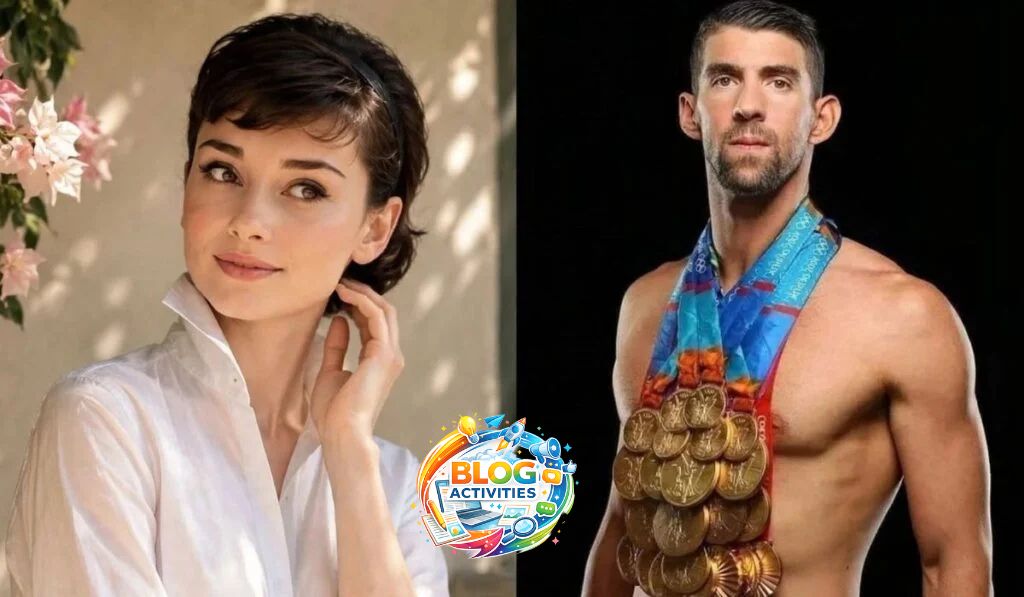
Michael Phelps was born on June 30, 1985, in Baltimore, Maryland. Unlike Hepburn, whose fame came through performance and storytelling, Phelps built his international reputation through competitive swimming.
His Olympic career stretched from Athens 2004 through Rio 2016. According to the Olympics’ official athlete profile, Phelps won 28 Olympic medals, including 23 gold, three silver, and two bronze.
Those numbers made him one of the most recognizable athletes in Olympic history. His success was not limited to a single event. He competed across several swimming disciplines and became known for performing at the highest level over multiple Olympic Games.
Phelps’s career also helped bring greater public attention to competitive swimming. For many casual sports fans, his performances turned individual swimming events into major international moments.
Two Different Paths to Fame
The connection between Audrey Hepburn and Michael Phelps is not based on a shared profession or a documented personal relationship. Instead, their stories provide an interesting comparison of two different forms of international fame.
Hepburn’s fame was built through acting, while Phelps’s was built through sport. Hepburn used performance to create characters audiences remembered. Phelps used athletic ability and years of competition to produce results that became part of Olympic history.
Their eras were also very different. Hepburn became famous during the golden age of Hollywood, when cinema and major film stars had enormous influence on popular culture. Phelps rose to prominence in a global media environment shaped by television, the internet, social media, and continuous sports coverage.
Despite these differences, both became recognizable far beyond their professional fields.
Audrey Hepburn’s Career Achievements
Hepburn’s acting career was notable for its range. She could play romantic, dramatic, comedic, and sophisticated roles without losing the qualities that made her distinctive.
Roman Holiday remains one of the defining films of her career. Her performance combined humor, warmth, and vulnerability, helping establish her as a major Hollywood star.
She continued to work with important directors and performers throughout her career. Films such as Sabrina and Breakfast at Tiffany’s became particularly influential in popular culture. Her role as Holly Golightly in Breakfast at Tiffany’s became one of the most recognizable character portrayals associated with her name.
Hepburn also received significant recognition from the Academy. Her career included several Academy Award nominations, and her humanitarian contributions were recognized by the Academy with the Jean Hersholt Humanitarian Award. The Academy records note that the award was conferred in 1993, shortly before her death, and was accepted on her behalf by her son, Sean Hepburn Ferrer.
Her achievements demonstrate that her reputation was not built around a single performance. Instead, it developed over years of work and continued to grow after her major acting period.
Michael Phelps’s Sporting Achievements
Michael Phelps’s Olympic record is the clearest foundation of his fame.
Across four Olympic Games, he collected 28 medals, with 23 gold medals. The Olympics identifies him as the most decorated Olympian, and his medal total remains a central part of his sporting legacy.
His achievements were particularly remarkable because they were spread across several Olympic cycles. Success at one Games can be difficult enough for an athlete, but maintaining elite performance over many years requires sustained preparation and consistency.
Phelps also competed successfully in multiple swimming events. His Olympic career therefore represents more than a collection of medals. It demonstrates the breadth of his abilities within the sport.
His influence can also be seen in the attention given to swimming during the years of his greatest success. Major international competitions involving Phelps became widely followed events, introducing his performances to audiences who might not otherwise have closely followed swimming.
Influence Beyond Their Main Careers
The most interesting part of comparing Audrey Hepburn and Michael Phelps is what happened beyond their primary professions.
For Hepburn, acting eventually became only one part of her public identity. She became strongly associated with humanitarian work, particularly through UNICEF.
For Phelps, swimming established his reputation, but his later work expanded his public role into areas such as water safety, mental wellness, healthy living, and youth development.
In both cases, their fame gave them a platform that could be used for purposes beyond entertainment or competition.
That does not mean their careers were identical. Their causes, organizations, and methods were different. The similarity lies in the broader idea that a famous career can create opportunities for public service and advocacy.
Audrey Hepburn’s Humanitarian Legacy
One of the most important developments in Hepburn’s later life was her work with UNICEF.
She became a UNICEF Goodwill Ambassador in 1988. According to UNICEF, she traveled to countries including Ethiopia and used her public profile to draw attention to children facing severe hardship. Her work included field visits, public appearances, and interviews intended to raise awareness of children’s needs.
Her humanitarian work was particularly meaningful because of her own childhood experiences during World War II. UNICEF notes that Hepburn had experienced receiving food and medical relief as a child, which contributed to her long-standing connection with the organization.
This part of her life changed how many people understood her public identity. She was no longer known only as a film star or fashion icon. She became an advocate who used her visibility to draw attention to children and humanitarian issues.
Her UNICEF work also became an important part of the way her life is remembered today.
Michael Phelps’s Legacy Beyond the Pool
Phelps has also extended his work beyond competitive swimming.
The Michael Phelps Foundation focuses on helping young people through water safety, mental wellness, healthy living, and confidence-building programs. Its signature IM Program combines these areas with swimming and life-skills education.
Water safety is especially relevant to Phelps because swimming has been central to his life and career. Rather than limiting his connection with the sport to elite competition, his foundation works to help young people become more comfortable and capable around water.
The foundation also emphasizes mental wellness and confidence. Its programs include lessons involving emotional wellbeing, goal-setting, healthy living, and resilience.
Its work has also extended through partnerships with organizations such as Special Olympics. The foundation describes programs designed to help participants develop swimming skills and greater confidence in the water.
This gives Phelps’s post-competition career another dimension. His legacy is connected not only to what he achieved as an Olympic swimmer but also to how his name has been used to encourage young people to develop practical skills and confidence.
What Makes Their Legacies Last?
Fame can be temporary. Legacy is usually more complicated.
A person may become famous for a particular achievement, but lasting recognition often depends on whether that achievement continues to matter to later generations.
Hepburn’s films remain accessible to new audiences, while her style continues to influence discussions of classic fashion. Her humanitarian work adds another layer to her public story.
Phelps’s Olympic performances remain part of the historical record of the Games. His medal total provides a clear measure of his sporting achievements, while his foundation gives his name a continuing connection with youth programs and water safety.
Another factor is recognizability. Both Hepburn and Phelps developed identities that could be understood quickly around the world. Hepburn became associated with classic cinema and elegance. Phelps became associated with Olympic swimming and extraordinary competitive achievement.
Their legacies therefore combine professional accomplishment with cultural memory.
A Closer Comparison
Although their careers cannot be measured by the same standards, several differences and similarities are useful to consider.
| Category | Audrey Hepburn | Michael Phelps |
|---|---|---|
| Main field | Film and entertainment | Competitive swimming |
| Birth year | 1929 | 1985 |
| International platform | Hollywood cinema | Olympic sport |
| Major achievement | Award-winning acting career | 28 Olympic medals |
| Cultural influence | Film, fashion, and humanitarian work | Swimming, sport, and youth programs |
| Humanitarian focus | Children’s rights and UNICEF | Water safety, mental wellness, and healthy living |
| Career legacy | Classic cinema and humanitarian service | Olympic achievement and community programs |
The comparison shows why placing their names together can be interesting without suggesting that they had the same type of career.
Why Their Stories Still Matter
People continue to revisit Hepburn’s story because her work has remained culturally recognizable. Her films are part of classic cinema, while her personal style has become a reference point for later generations.
Phelps’s story remains relevant because Olympic achievements provide a lasting record of sporting history. His 23 gold medals and 28 total Olympic medals are statistics that clearly communicate the scale of his competitive career.
There is also a human element to both stories. Their public careers were not simply collections of achievements. Each person became associated with values and causes beyond the original source of fame.
Hepburn’s later humanitarian work showed a commitment to children’s welfare. Phelps’s foundation focuses on helping young people develop water-safety knowledge, confidence, healthy habits, and mental-wellness awareness.
That broader influence helps explain why both names remain recognizable long after individual performances or competitions have ended.
A Legacy Larger Than Fame
Audrey Hepburn and Michael Phelps represent two very different versions of international success.
Hepburn became a lasting figure in film and fashion before dedicating significant energy to humanitarian work. Phelps became one of the most decorated Olympic athletes in history and later expanded his work into youth development, water safety, and wellbeing.
Their professions were different, their generations were different, and their achievements cannot be directly measured against each other. What can be compared is the way their professional success created a platform that extended beyond the original source of their fame.
Hepburn’s legacy continues through her films, cultural influence, and humanitarian work with UNICEF. Phelps’s legacy continues through the historical record of his Olympic achievements and programs connected with his foundation.
Ultimately, their stories demonstrate that fame can open the door to a much larger legacy. The achievements that first make someone famous may be remembered for decades, but the influence they create beyond those achievements can become an equally important part of how future generations understand their lives.
How to Use Tips Lwspeakstyle for Everyday Improvements
FAQs
Who was Audrey Hepburn?
Audrey Hepburn was a British actress and humanitarian best known for major films such as Roman Holiday, Breakfast at Tiffany’s, and My Fair Lady. She later became an internationally recognized UNICEF Goodwill Ambassador.
Who is Michael Phelps?
Michael Phelps is an American swimmer and one of the most decorated Olympians in history. He won 28 Olympic medals, including 23 gold medals, across four Olympic Games.
What made Audrey Hepburn famous?
Hepburn became famous through her film career, beginning with her breakthrough performance in Roman Holiday. Her acting, distinctive screen presence, and fashion influence helped make her an enduring cultural figure.
What is Michael Phelps best known for?
Phelps is best known for his Olympic swimming career. His record of 28 Olympic medals, including 23 gold medals, is the central achievement associated with his international sporting legacy.
Were Audrey Hepburn and Michael Phelps connected?
There is no established personal or professional connection between them. They are discussed together mainly as two internationally recognized figures whose careers produced lasting cultural legacies in very different fields.
What is Audrey Hepburn’s humanitarian legacy?
Hepburn served as a UNICEF Goodwill Ambassador from 1988 and traveled internationally to raise awareness about children’s needs. Her humanitarian work became an important part of her legacy alongside her film career.
What does the Michael Phelps Foundation do?
The Michael Phelps Foundation works in areas including water safety, mental wellness, healthy living, swimming, and confidence-building for young people.